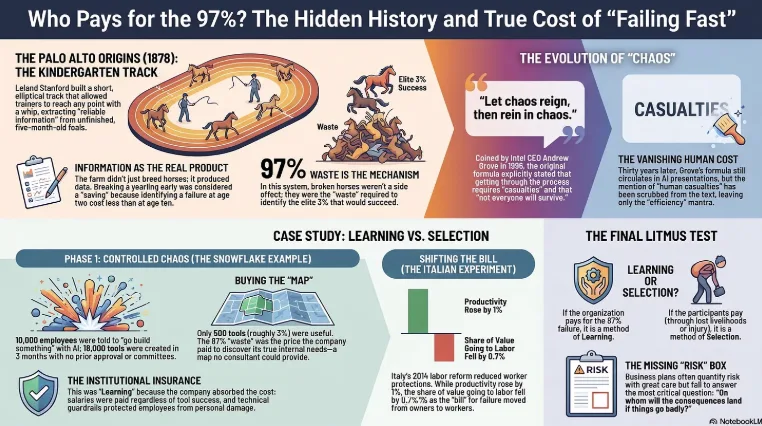
The vocabulary of “fail fast” comes from horse breeding.
In 1878, on his estate at Palo Alto, Leland Stanford had a training track built shorter than the standard oval. He called it the kindergarten track, borrowing the name from the German pedagogical movement that was crossing the Atlantic in those years. Foals of five months ran on it.
The reduced dimensions were not an aesthetic whim. They allowed two trainers, stationed at the two foci of the ellipse, to reach any point on the course with a whip without ever having to move. The premise was that one need not wait for an animal to reach maturity in order to know what it was worth: that reliable information about its future value could be extracted at once, from a body still unfinished. That information, and not the horses, was the farm’s real product.
Observers of the period recorded, without undue distress, that trotting yearlings at such speeds caused the occasional tendon to give way, and that good material was lost in this manner.
The farm’s manual answered with a perfectly lucid piece of accounting: if an animal is going to prove a failure, better that it does so at two years old than at ten, because early failure costs less.
Failing fast was already a saving rather than a defeat.
The vocabulary does not come from computing
Malcolm Harris, in Palo Alto: A History of California, Capitalism, and the World, calls all this the Palo Alto System, taking up the name its own inventors gave it, and spends seven hundred pages demonstrating that the method never stayed in the stables. Harris was born there, and to describe his own city he reaches for a word no materialist should permit himself: Palo Alto is haunted. Not by ghosts, he specifies, but by a past that cannot be got past.
I came to this story through Paolo Benanti, always worth reading, who in a recent piece drew out an aspect of it I had never noticed. I give it in his words, because the formulation is his and I have no wish to pass it off as mine: that vocabulary does not come from computing but from Californian animal husbandry of the nineteenth century, and what computing has made of it is a quotation, not a metaphor.
When somebody in a meeting says “fail fast”, everyone in the room believes they are quoting software engineering. Nobody is thinking about horses. Yet the original formulation of the principle, with its economic justification stated in the open, sits in a breeding manual, and says precisely the same thing: bringing failure forward reduces the capital burned.
There is a second aspect, which interests me more. In that method, the waste is not a side effect. It is the product. The farm did not breed horses and break a few by mistake. The farm produced information, and broken horses were the mechanism by which the information was produced. Anyone who has ever written a business plan knows that a production line running at 97% waste would be shut down the following morning. That figure, 97%, is not one I chose at random.
Chaos, too, has an author
Before we reach the present, it is worth pausing on a second formula, because the mechanism repeats itself and is easier to see the second time.
Let chaos reign, then rein in chaos. The phrase circulates today in presentations on artificial intelligence as though it were a recent discovery, and is generally credited to whichever company happens to be using it. It belongs to Andrew Grove, chief executive of Intel, and appears in Only the Paranoid Survive, published in 1996. Grove uses it to describe what a leader must do when the fundamentals of an industry are shifting: loosen its grip, allow action from below to pull the company in many directions at once, and only afterwards take the direction back in hand.
So far, the formula as we know it. But in the same passage, Grove adds something nobody repeats anymore: getting through that process, he writes, requires casualties and personal transformation, and requires accepting that not everyone will survive, and that those who do will not be the same as before.
In 1996 the human cost was declared inside the formula. Thirty years on, the formula still circulates, intact, and the casualties have gone from the text.
Formulas survive. The price that accompanied them does not.
This holds for the failing fast of the Palo Alto farm, and it holds for Grove’s chaos. Twice over, the same mechanism, and on neither occasion is there any need to suppose bad faith in those who use it. Nobody can return a cost they know nothing about.
The case where it works, and works well
Now that we have that behind us, back to the present, and to the case most favourable to the argument opposed to mine.
I take it from Giuseppe Mayer, who in his newsletter DottorMayer described how Snowflake, one of the largest data companies in the world, is said to have approached its own transformation with artificial intelligence by declaring a strategy in two movements: first let chaos reign, then rein it in. The account opens by contrast with an image familiar to anyone working in Europe, that of the company which has already convened the committee, already produced forty pages of guidelines, and already deferred all experimentation until the moment the regulation is approved.
Phase one: an internal development tool handed to nearly ten thousand employees, four thousand of them in sales, with a single instruction: go and build something. No use cases approved in advance, no request procedure, no committee. In three months, eighteen thousand tools were built, between applications, dashboards, and small agents. The genuinely good ones numbered around five hundred.
Phase two: the sales staff were told to go back to selling, because in the meantime the company had understood what they needed and could have it built by people who do that for a living. Out of the behaviour observed during the chaos came, among other things, an internal agent that replaced two hundred and fifty of the sales department’s dashboards and now fields thirty thousand requests a day. Development sprints went from three weeks to one.
The point that account makes well, and to which I have no objection, is that the value of those three months lay not in the tools built but in what they revealed. By watching what people build when nobody gives them a brief, the company saw for the first time the real map of its own needs. No internal survey and no consultancy could have produced that map. And the 97% thrown away is the price of the map.
I would add that the obvious objection, that ten thousand people building without permission is a security nightmare, receives a serious answer there: the chaos reigned inside technical guardrails, not regulatory ones. Data permissions sat in the systems rather than in the documents, and anyone building anything could touch only the data their role already gave them access to.
One clarification is owed to the reader before we go on. I looked for primary sources for these figures and did not find them. The account attributes the numbers to statements by the company’s chief information officer but does not document them, and the data the company publishes on its own account do not entirely tally: the headcount declared in recent years is lower, and the internal assistant it describes reports usage volumes of a different order of magnitude. I have no reason to doubt anybody’s good faith, and the substance of the argument does not turn on a decimal place. But I shall treat what follows for what it is, a story in circulation, and not a documented case.
That said, the argument is a strong one, and it interests me precisely because it is strong. Which is exactly why it is worth asking what, in that story, is never named.
The word that never appears
The account is built against governance, and on that point it is right: the committee that writes forty pages is regulating behaviour it has not observed, and ten people shut in a room will always find a thousand reasons why something cannot be done. But in saying so it holds together two objects that need separating, because one can be removed and the other cannot.
The committee is procedure. The salary that goes on arriving while you build one of the seventeen and a half thousand tools destined for the bin is another matter entirely.
An institution is not what forbids failure. It is what absorbs the cost of failure on your behalf.
Remove the first and the system accelerates. Remove the second and you are not running the same experiment faster: you are running a different one, which resembles the first only in its vocabulary.
From which follows a test more useful than any definition.
To recognise an institution, do not look at what it forbids.
Look at where the bill lands when the experiment goes wrong.
Who paid for the 97%
Let us apply it. Eighteen thousand tools built, five hundred good ones: who paid for the difference?
Not the people who built it. Salaries were not contingent on a tool succeeding. The time spent was declared working hours, and here there is a sentence that passes in the account as a detail of company culture and is in fact the load-bearing clause of the whole operation: employees were told they were being paid to learn this material. Not at weekends, not if time allowed. And data permissions sat at source, which means that not even a serious error could turn into personal damage.
The failure landed in a line of the accounts. The price of the map is the exact phrase, provided one reads it to the end: a map is something you buy, and in this case the company bought it.
It is worth noting, and I leave it here because it deserves a discussion of its own, that the phrase tells us what the map cost and says nothing about who drew it.
The chaos was mature because it was insured. That is not a criticism; it is the condition that made the result possible. None of the operational advice that account offers works without it, and anyone copying it who takes home the chaos without taking home the insurance is copying the wrong half.
The same arithmetic, with the floor removed
Back to the kindergarten track, where the calculation of capital does not change by a comma. There too, early failure costs less than late failure; there too, the experiment produces valuable information; there too, the accounting is lucid. One thing alone changes, and it is where the bill lands.
The severed tendon appears in no ledger, because it is not a cost to the business. It is a cost to the animal. The period phrase about good material being lost registers the phenomenon and, in the same breath, makes clear at whose expense: lost to the farm, which had a great many others.
An Italian experiment, with receipts
It will be said that this is nineteenth-century animal husbandry, and that there is some difference between a foal and an employee. Let us take something closer to hand, then, which has the rare merit of having been measured properly.
Under Italy’s 2014 labour reform, in force from the following year, employees newly hired by firms above fifteen staff lost the right to reinstatement in cases of unfair dismissal, which was replaced by graduated financial compensation, while smaller firms remained outside the new regime. That threshold produced, without intending to, an almost perfect natural experiment, and two economists, Gabriele Ciminelli and Guido Franco, exploited it in a paper published by the OECD in 2025. The finding comes in two halves, and has to be taken whole, because one half tells against me.
The first half. Total factor productivity in the firms affected by the reform rose by roughly one per cent relative to control firms, on average, in each of the five following years, with slightly larger gains in labour productivity. Lowering the floor works. This is not ideology, it is an estimate with a sound identification design. Those who argue that making failure cheaper makes a system more efficient have the numbers on their side here, and those who deny it are cheering for a team.
The second half. The same authors then measure how that gain was distributed, and find that the owners of capital benefited most: the share of value added going to labour fell gradually, reaching seven tenths of a percentage point after five years.
Two faces of the same coin. The system learned, the bill moved by one step, and the two movements do not contradict each other in the slightest: they are the same movement seen from two sides. The reform did what it promised to do, and it also did the other thing, the one less often discussed, because noticing it means looking not at the size of the gain but at its addressee.
It should be added, in fairness to the reader, that the regime in question is no longer what it was. The window the study measures is the five years following its entry into force, when the new rules were fully operative. Since then Italy’s Constitutional Court has dismantled a substantial part of it, in a succession of judgments beginning in 2018 and thickening in recent years, restoring reinstatement in cases the reform had excluded.
Which, rather than weakening the argument, shows how it works. The floor has been partly put back, but not at the moment it was removed: one piece at a time, through the courts, nearly a decade later. By then the productivity gain had been banked, and the share deriving from it had already gone where it was going to go. Corrections arrive, when they arrive, at the speed of a judgment. Bills move at the speed of a financial year.
On this lag Benanti has written, in another piece, the finest page I have read, using an isotope of nitrogen and the spruces of an Alaskan forest to show how certain damage becomes legible only once it is beyond repair. His question is whether the bill is still reversible.
Mine, more prosaic, is whose name is on it.
Learning or selection
Here is where a single word covers two different operations.
Where the cost of failure falls on whoever organises the experiment, failing fast is a method of learning. Where it falls on whoever takes part in it, failing fast is a method of selection.
The vocabulary is identical. Efficiency is measurable in both cases and real in both cases: the Palo Alto farm produced faster horses, and it genuinely did produce them. The system learns either way. The difference lies not in whether but in who, and it is not a moral nuance appended after the fact to a technical matter: it is the variable that distinguishes two machines sharing one instruction manual.
It is worth saying that neither machine requires ill intent in order to run. Nobody at the farm hated the foals, and no director in an Italian firm in 2014 dismissed anyone for the pleasure of it. The decisions were all rational, taken one at a time, each defensible before a board. Costs shift even when nobody deliberately shifts them, which is precisely why it pays to have a question ready.
The question to ask before launching an experiment is not whether it might fail. That one is easy, and the answer is always yes. It is who pays if it does.
If the answer is the organisation, you are buying a map. If the answer is the participants, you are not running an experiment: you are running a selection, and it would be cleaner to call it by its name.
Coda
Between the late nineteen-nineties and the early two-thousands I spent a good deal of time assessing business plans and applications for public funding. Forms, grids, scores. There was always a section on risk, and one judged whether the risks had been correctly identified, whether the mitigations were credible, whether the projections held up under the worst case.
In none of those forms, and in none of the ones I wrote from the other side of the table, was there a box asking on whom the consequences would land if things went badly. Risk was quantified with great care, and never addressed to anyone.
I still do not see that box.
Sources
Malcolm Harris, Palo Alto: A History of California, Capitalism, and the World, Little, Brown and Company, 2023. For the Palo Alto System, the kindergarten track and the accounting of early failure.
Paolo Benanti, La città che allevava cavalli e poi ha allevato noi, substack.com/@benanti, 2 August 2026. Source of the kindergarten track story and of the observation on the animal-husbandry origins of the vocabulary of rapid failure.
Paolo Benanti, Gli abeti del Tongass sono fatti per un quarto di salmone, substack.com/@benanti, 23 July 2026. On entry-level work as an invisible vector, and on the lag with which certain damage becomes legible.
Andrew S. Grove, Only the Paranoid Survive, 1996. For the formula on letting chaos reign and reining it in, and for the passage in which the human cost of the transition is stated openly.
Giuseppe Mayer, Lascia regnare il caos, DottorMayer newsletter, 2 August 2026, dottormayer.substack.com. Source of the Snowflake account drawn on in this piece.
Gabriele Ciminelli and Guido Franco, Job protection deregulation, productivity and the distribution of income in Italy: Firm-level evidence from the Jobs Act, OECD Productivity Working Papers no. 37, OECD Publishing, Paris, 2025.